


Authenticating a painting rarely relies on a single piece of evidence. Provenance, stylistic expertise, imaging and material analyses are generally combined to assess whether an artwork is consistent with an artist’s known practice.
The use of surface metrology for painting authentication is an emerging application that examines the fine geometry of the picture. This microgeometry can reveal characteristic features about the painting’s complexity, shaped by the artist’s pictorial gestures.
In a recent study, François Berkmans and colleagues at the Polytechnic University of Hauts-de-France and at the LAMIH UMR CNRS 8201 laboratory, investigated whether this pseudo-topographical complexity could provide quantitative information to help the authentication of paintings by Vincent van Gogh. Van Gogh is particularly interesting for this study because his work is known for strong structured brushwork, directional patterns and highly variable pictorial textures.
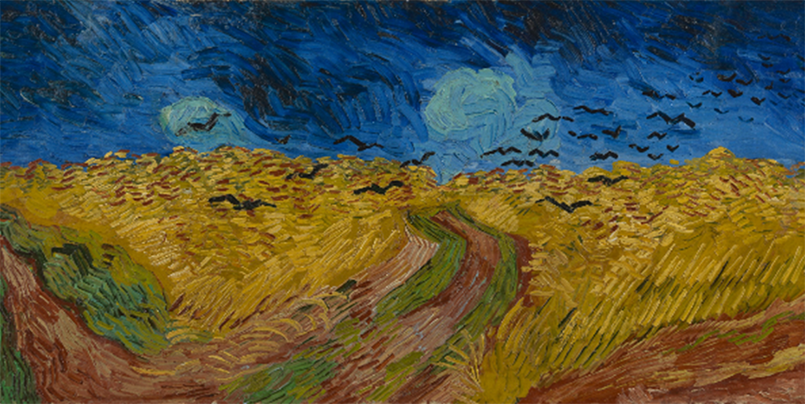
Above. Image of the painting Wheatfield with Crows from the authentic paintings catalogue of Van Gogh.
From images to topographic surfaces
High-resolution images of authentic Van Gogh paintings were transformed into topographic representations using MountainsMap® software. First, the color images were converted into grayscale. Then, the variations in grayscale intensity were used to define surface-like height variations. Turning the images into topographic maps makes it possible to analyze the pictorial texture using concepts commonly applied in surface metrology.
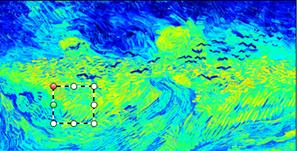
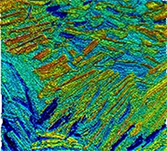
Above left. Image of the painting Wheatfield with Crows converted into surface topography. Above right. 3D topography details of the extracted area.
Fractal analysis for characterization of surface complexity
The main descriptor investigated in this study was the areal fractal dimension (Sfd parameter). Fractal analysis describes how geometrical complexity evolves across scales. A perfectly smooth plane has a dimension of 2, while an increasingly complex surface occupies the three-dimensional space more intricately and therefore exhibits a fractal dimension progressively approaching 3. Sfd can consequently provide a compact numerical description of the multiscale complexity of a painting’s pseudo-topography.
A reference distribution was first established from paintings accepted as authentic works by Van Gogh. Two particularly interesting cases were then compared with this reference. Sunset at Montmajour, the attribution of which was debated for many years before being accepted as an authentic Van Gogh work, presented a fractal dimension compatible with the reference group, with a Z-score of +1.64. By contrast, The Plowmen, a known forgery, appeared as an outlier with a Z-score of −2.336.
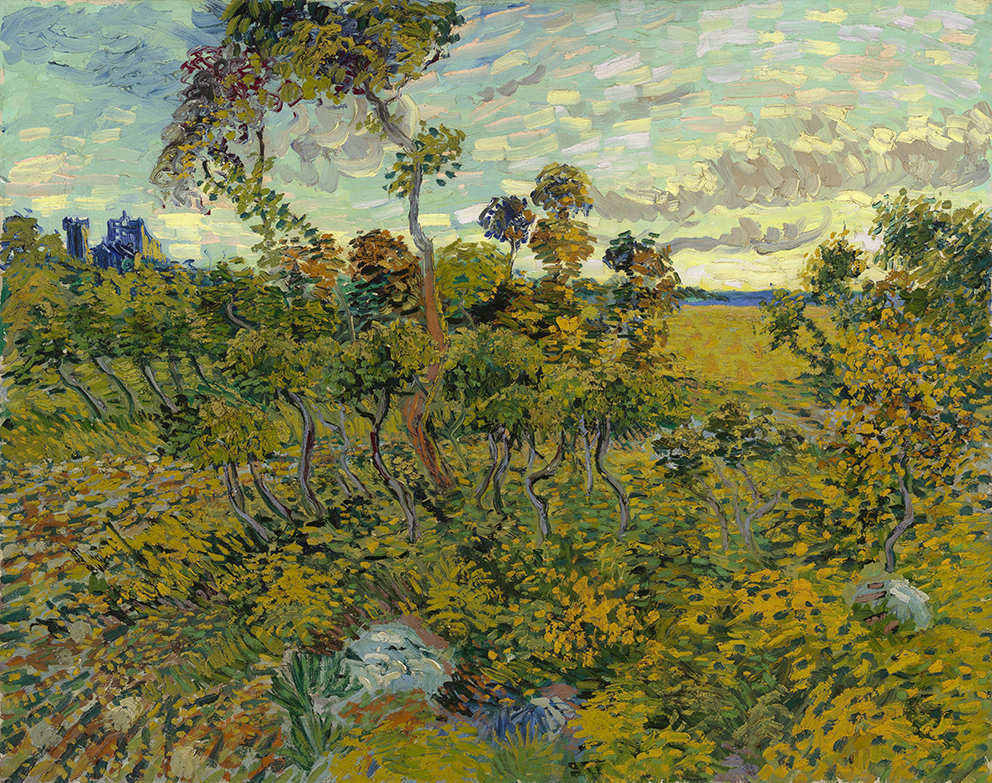
Above. Image of the painting Sunset at Montmajour by Van Gogh.
The approach was also explored beyond a single artist. Works by Van Gogh were compared with paintings by the seventeenth-century artist David Klöcker Ehrenstrahl. Their fractal-dimension distributions showed a clear shift, suggesting that multiscale complexity can capture differences associated with illustration practices.
Conclusion
A single numerical parameter can’t, of course, authenticate a painting on its own. However, fractal surface analysis can provide an additional quantitative indicator alongside provenance, art-historical expertise, chemical analysis and imaging.
More broadly, this work illustrates how tools developed for engineering surface metrology can be transferred to cultural heritage, turning pictorial texture and visual complexity into measurable information.
References
Berkmans F., Nys L., Bigerelle M. Preserving Van Gogh’s painterly heritage: topographical and fractal insights in authentication. Surface Topography: Metrology and Properties, 14(2), 025016, 2026. https://doi.org/10.1088/2051-672X/ae7136
Instruments & software used
Digital images + MountainsMap® software
More surface topography analysis stories
- Understanding brake friction through multi-scale surface analysis
- Revealing key topographic parameters in surface bacterial adhesion
- Imaging fish scale topography in situ