


By Benoit Zupancic, product manager for SEM applications at Digital Surf

Scanning electron microscopes are extraordinary imaging tools, capable of revealing surface details far beyond the reach of optical microscopy. But SEM images are two-dimensional: they show contrast and morphology, but not directly measurable topography.
Stereoscopic reconstruction changes this perspective.
By combining two SEM images acquired at different tilt angles, it is possible to reconstruct a true 3D surface and extract quantitative measurements such as height, depth, roughness and slope angles. While the concept is increasingly familiar, one important question remains for many SEM users:
Can height values of reconstructed SEM topography be trusted?
A recent comparison performed on femtosecond laser-machined metallic samples provides a compelling answer.
Comparing SEM stereoscopic reconstruction with profilometer measurements
The FEMTO Engineering laboratory (Besançon, France) provided several datasets acquired on laser-engraved metallic structures. The same features were measured using:
- a scanning electron microscope and stereoscopic SEM image reconstruction performed with MountainsSEM® software
- a mechanical profilometer (Bruker Dektak XT)
The objective was simple: compare the reconstructed 3D measurements with reference profilometry data.
Three different geometries were evaluated:
- Hole depth measurement
- Gentle slope measurement
- Steep slope measurement
The results showed remarkably strong agreement.
Example 1 – Measuring the depth of a laser-machined hole
For the first sample, the depth of a laser-machined feature was measured both from the reconstructed SEM surface and with the profilometer.
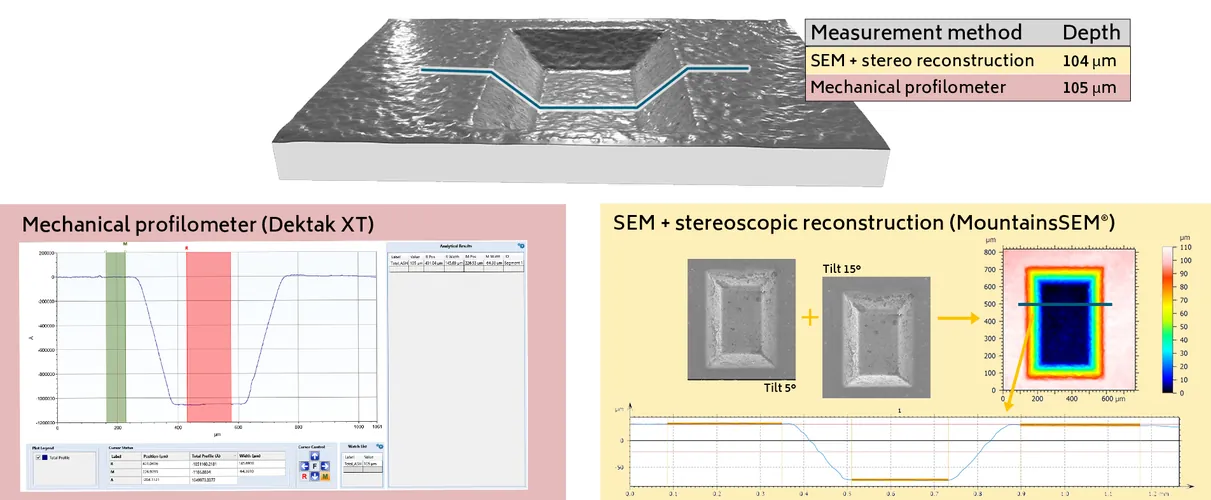
The difference between the two measurements was only 1 µm.
This result demonstrates that stereoscopic reconstruction can provide reliable quantitative depth information directly from SEM imagery, without requiring an additional topography instrument.
Example 2 – Measuring a gentle slope
The second example focused on a gently inclined surface.
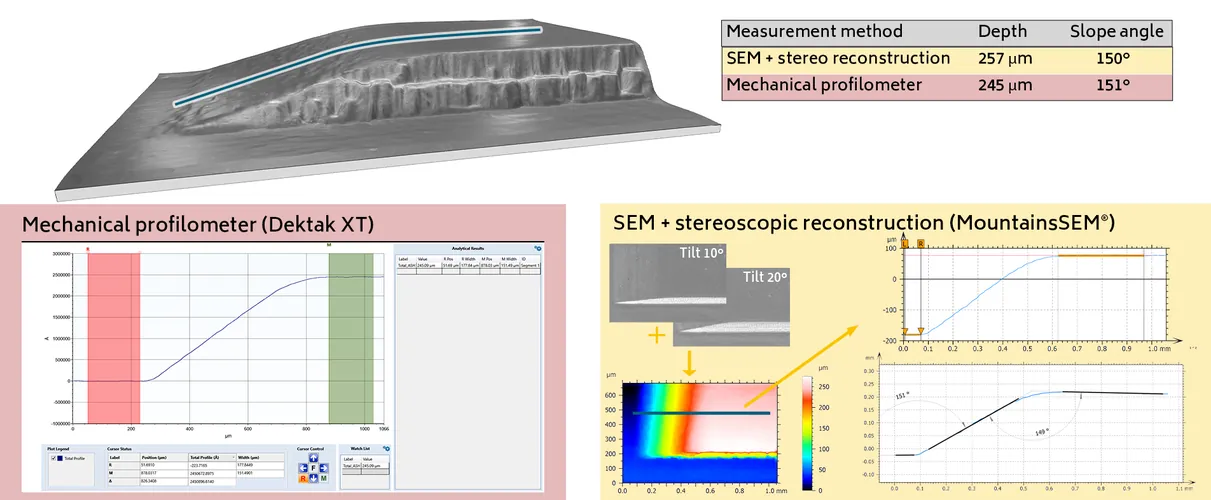
Again, the correlation is extremely close.
Not only are the reconstructed surfaces visually clean and coherent, but the extracted dimensional values are also consistent with profilometer measurements. This is particularly important for applications involving laser texturing, microfabrication, coatings or wear analysis, where slope information can be just as critical as height data.
Example 3 – Measuring a steep slope
The third dataset revealed an additional advantage of SEM reconstruction.
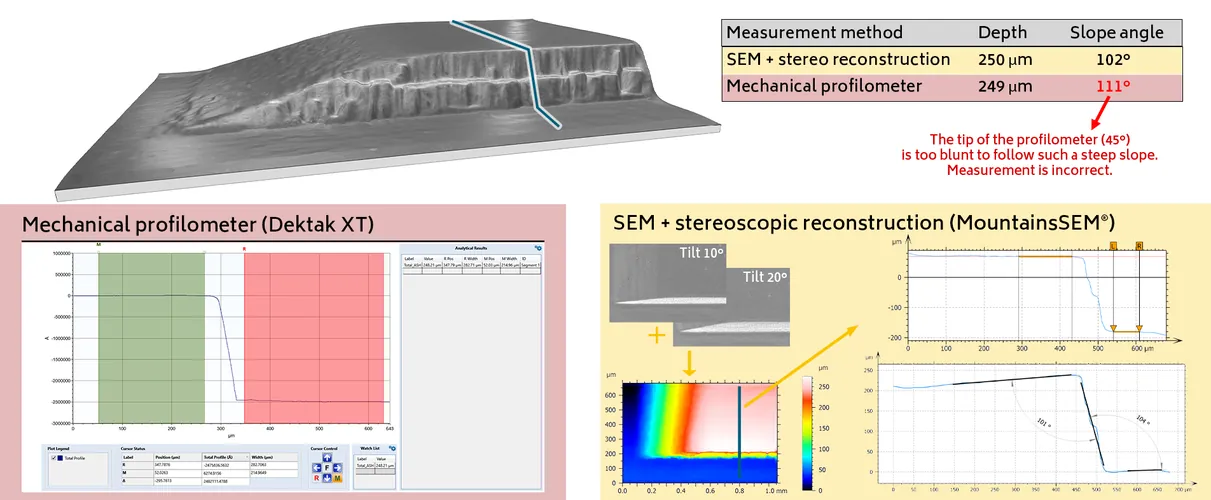
Depth values remained consistent between both methods. However, the profilometer struggled to correctly follow the steep geometry.
The reason is physical: the profilometer stylus tip, with its finite geometry, cannot accurately access very steep sidewalls. In this case, the measured slope angle becomes distorted.
SEM stereoscopic reconstruction does not suffer from the same mechanical limitation.
Because the topography is reconstructed directly from image information, steep features can often be characterized more faithfully than with contact profilometry.
Why this matters for SEM users
Many SEM users already possess the data needed for 3D analysis without realizing it.
With only two tilted SEM images, stereoscopic reconstruction can transform conventional SEM acquisitions into quantitative topography datasets. This opens the door to:
- measuring depths, heights and volumes
- analyzing slopes and complex geometries
- characterizing laser texturing and micro-machining
- evaluating wear, defects and surface damage
- obtaining 3D information without additional hardware
For laboratories that already rely on SEM imaging, this represents a powerful way to extract more value from existing workflows.
From imaging to quantitative surface analysis
These comparisons with profilometer measurements show that stereoscopic SEM reconstruction is not only visually convincing but that it can also deliver metrologically meaningful results.
For many applications, SEM images no longer need to remain purely qualitative.
With stereoscopic reconstruction in MountainsSEM® software, they become measurable 3D surfaces.
Digital Surf would like to thank the team at FEMTO Engineering for their collaboration, technical expertise and support in making this article possible.
Author : Benoit Zupancic