


As atomic force microscopy (AFM) celebrates its 40th anniversary, the technology continues to evolve beyond high-resolution imaging toward increasingly automated, multimodal and quantitative characterization. In this article, Dalia Yablon, AFM specialist and longtime contributor to the microscopy community, explores the key innovations shaping the field and the growing role of advanced data analysis in nanoscale research.


Above. Birth and rise of AFM over the last 40 years.
It’s been 40 years since a group of academic and industrial scientists invented atomic force microscopy. In their seminal paper “Atomic Force Microscope” published in 1986 in Physical Review Letters, Gerd Binnig and Christoph Gerber of IBM Zurich and Calvin Quate, of Stanford University focused on the versatility of this technique – “capable of investigating surfaces of insulators on an atomic scale”, demonstrated that it was non-destructive “…probe that does not damage the surface” and underlined its remarkable resolution “lateral resolution of 30Å and a vertical resolution less than 1 Å”. While none of that has changed, AFM has continued to grow and evolve to become the premier nanoscale characterization technique for topography together with electrical, mechanical, and optical properties in any environment.
The first instruments were a bit more difficult to use than the current ones, many of which boast among other major conveniences automated laser alignment, automated tip approach, and commercially fabricated cantilevers (although for most instruments, the need to handle and mount cantilevers with tweezers remain an annoying “feature”!). But some other significant hardware developments have been commercialized in the 2010s and 2020s (even though they were initially proposed and demonstrated decades ago) that have truly moved the field forward. Several manufacturers now offer photothermal cantilever excitation for dynamic (tapping) methods via lasers instead of piezos. This offers a much cleaner excitation and tune of the cantilever, which is especially important for imaging in fluid environments where the cantilever oscillations are significantly dampened. Another innovation that has become only recently commercially available is interferometric detection of the cantilever motion instead of the typical optical beam-based deflection, allowing for more accurate measurements of displacement. This has significant advantages for modes such as piezoforce microscopy.
Another area that has seen particular growth over the past decade and takes advantage of more advanced correlative methods is in the category of modes known as AFM-IR, which uses AFM based platforms to deliver high resolution chemical information from IR spectra that beats the diffraction limit together with the classic AFM information of topography and mechanical information. While there are many different implementations of AFM-IR, each with its own resolution limits, benefits and drawbacks, it has become evident that the ability to get sub-micron chemical information is a significant gap for major applications from semiconductor to the chemical industry. AFM-IR promises to be a growth area for years to come.
A recently developed novel approach to how we run AFM experiments that inverts the conventional AFM setup is Reverse Tip-Sample SPM. In this configuration, the sample is mounted onto a tipless cantilever and scanned over arrays or sets of probes. This approach paves the way for easier tip manipulation, taking away some of the daily hassle of handling delicate cantilevers and enabling faster measurements of the same sample with multiple probes.

Above. Mountains® workflow allows full AFM analysis traceability.
So far, the emphasis has been on hardware developments in the field of AFM. However, the corresponding development of image processing and analysis has been happening in parallel to meet the needs of the AFM community as it delivers data faster (though high-speed imaging) and generates significantly more complex outputs through correlative and multimodal methods. This is where Mountains® (and MountainSPIP®) comes into play, offering a complete environment designed around full traceability, smooth automation, and seamless multi-technique integration. Every processing step you apply is logged inside a clear workflow, making it simple to share and reproduce results or build standardized routines across different instruments.
At the same time, microscope manufacturers are starting to build AI directly into their instruments to automate smart scanning. Imagine running a quick, large-scale survey scan, and having the software automatically detect specific areas of interest based on mechanical properties like stiffness or adhesion, before zooming in with a higher-resolution acquisition right where it matters.
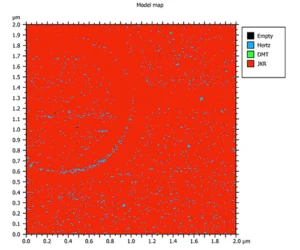
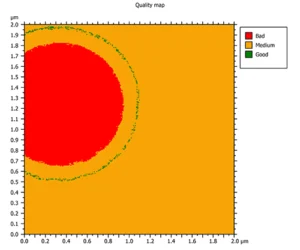
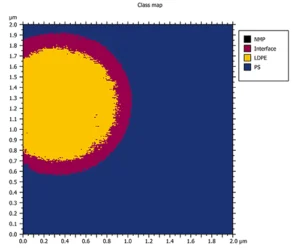
Above. Machine learning is already proving especially effective for sorting and clustering large force-distance curve datasets.
Artificial intelligence and machine learning represent a rapidly expanding focus within the Mountains® software suite and will play a major role in its future evolution. From streamlining particle analysis to assisting with complex SEM image segmentation, smart algorithms are progressively helping users extract meaningful insights from diverse imaging techniques.
In force spectroscopy, machine learning is already proving especially effective for sorting and clustering large force-distance curve datasets. By analyzing curve shapes and behaviors, Mountains® can quickly filter out artifacts and group similar curves together before any model fitting begins. Users can even train custom models through an active learning loop tailored to their specific materials. Once the data is curated, physical contact model selection (Hertz, DMT, or JKR) is guided automatically using the Tabor parameter, ensuring that final mechanical property maps reflect true physical contact mechanics rather than arbitrary curve fitting.
By bringing together state-of-the-art hardware acquisition and user-friendly, ML-boosted analysis, Mountains® makes nanoscale characterization faster, clearer, and far more reliable for the decades ahead.